
Barangay Clearance Requirements 2026: What to Bring, Fees & How to Apply
Before you can apply for a National Police Clearance, open a bank account, or even start your first job, you usually encounter one simple but required step: the Barangay Clearance. This document is often treated as a basic requirement, yet it plays an important role in almost every official process in the Philippines.
On the surface, it looks very easy to obtain. You go to your local barangay hall, pay a small fee, and receive your clearance. In reality, many applicants face delays or rejection because they are missing key requirements like a Cedula, bring the wrong type of ID, or confuse Barangay Clearance with Barangay Certificate. These small mistakes can stop the process entirely.
If you are searching for how to get Barangay Clearance, the complete requirements, cost, or whether online application is possible, this guide will serve as a clear roadmap. It removes confusion, explains the often-overlooked requirements, and shows why this document is a fundamental starting point for most government and employment transactions in the Philippines.
What is a Barangay Clearance? (Meaning and Purpose)
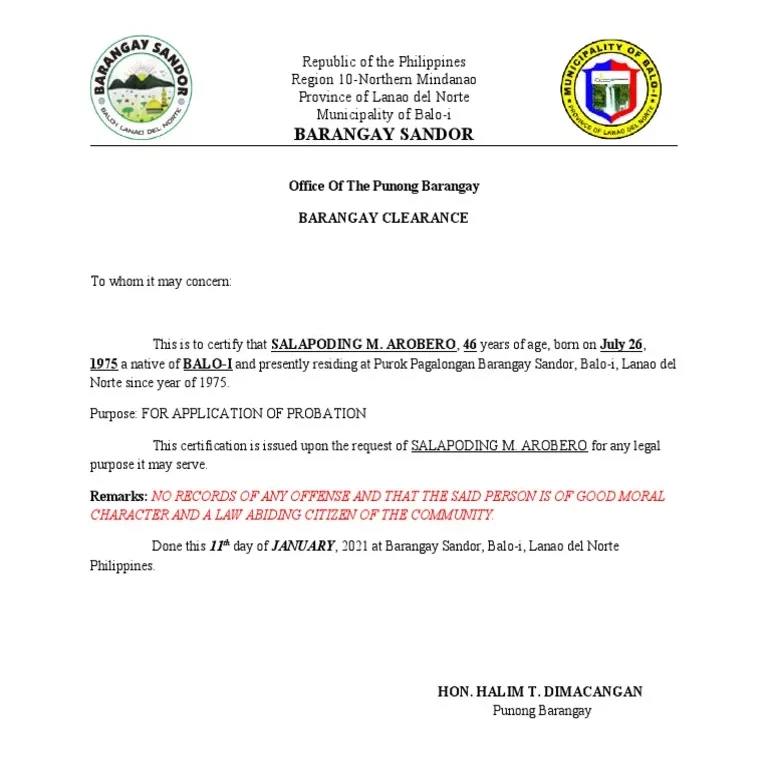
A Barangay Clearance is an official document issued by your local barangay office, which serves as the smallest administrative unit of government in the Philippines. It confirms that you are a registered resident of that area and are generally recognized as a responsible and law-abiding member of the community.
In simple terms, it is a certification that you have no known complaints, disputes, or derogatory records within your barangay. It is often required as proof of good standing before you can proceed with other government, employment, or financial transactions.
You can think of it as a local “good moral character” certificate—basically an assurance from your community that you are a trustworthy resident.
Barangay Clearance vs Barangay Certificate (Quick Comparison)
These two documents are often confused, but they serve completely different purposes. One focuses on your character within the community, while the other confirms your place of residence.
Feature | Barangay Clearance | Barangay Certificate (Residency) |
|---|---|---|
Main Purpose | Confirms good moral standing in the barangay | Confirms your residential address |
Focus | Character / community record | Proof of residence |
Common Use | Jobs, police clearance, business permits | Banks, address verification, indigency claims |
Evaluation | Checks for complaints or derogatory records | No character check |
Issued By | Barangay Office | Barangay Office |
Why Barangay Clearance Is Important? (Key Purposes)
A Barangay Clearance is often treated as a “gateway document” because it is rarely used on its own—it is usually required before you can complete other official processes. It helps confirm that you are a responsible resident with no recorded issues in your local community.
In most cases, it is needed for job applications, especially for local employment. It is also commonly required when applying for Police Clearance or an NBI Clearance, where background and identity verification are important.
For business owners, it is a basic requirement before obtaining a Mayor’s Permit. Some banks and lending institutions may also request it as supporting documentation for identity or address verification. In certain situations, it is even used when applying for government IDs like a Postal ID.
Complete Barangay Clearance Requirements (What You Need to Prepare)
To avoid delays, it is important to bring the correct documents when applying for a Barangay Clearance. Requirements may slightly differ depending on the barangay, but the following are generally required across most locations.
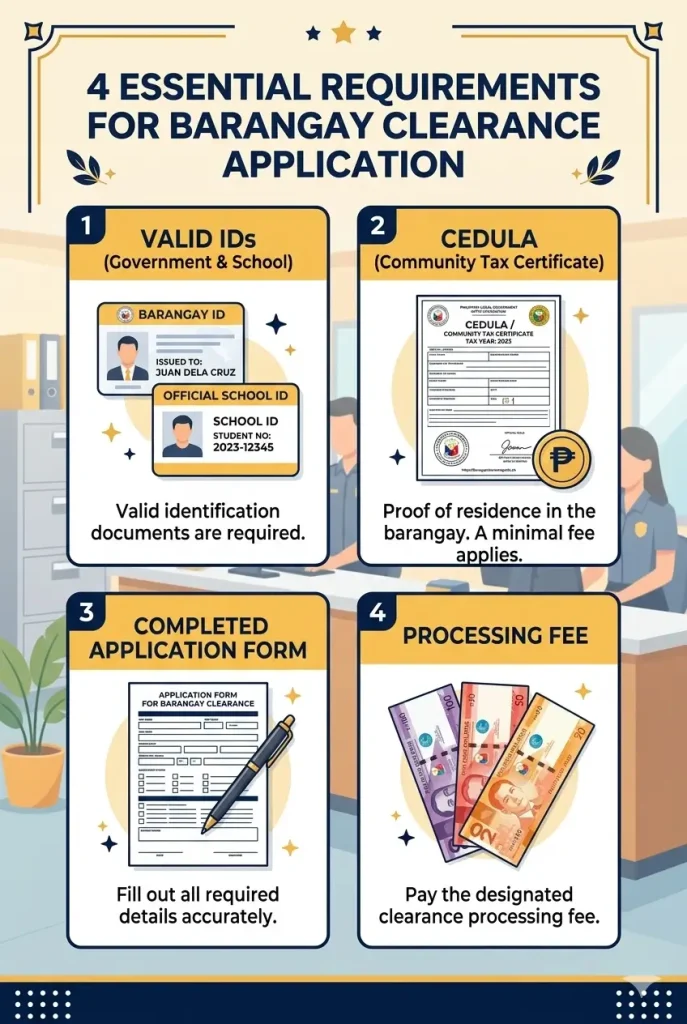
1. Valid Government or School ID
A valid ID is required to confirm your identity and residency details.
Commonly accepted IDs include: National ID, Passport, Driver’s License, Voter’s ID, PhilHealth ID, or UMID. For students, a school ID is usually accepted when applying for student-related purposes.
2. Community Tax Certificate (Cedula)
The Cedula is one of the most important but often overlooked requirements. Many barangays will not process your clearance without it.
You can obtain it from the Barangay Hall or City/Municipal Hall. The fee is usually minimal, often ranging from ₱20 to ₱50 depending on income declaration.
3. Completed Application Form
You will be asked to fill out a simple application form at the barangay office. It typically includes your personal information and the purpose of your request, such as employment, business, or ID application.
4. Processing Fee
A small administrative fee is required and is usually paid in cash. The amount varies depending on the barangay’s local policy.
Pro Tip for Smooth Processing
If you have recently transferred to a new barangay (usually within the last 6 months), some offices may require a Certificate of Transfer or an endorsement from your previous barangay. Preparing this in advance can help you avoid unnecessary delays and ensure faster approval of your Barangay Clearance.
How to Get Barangay Clearance in the Philippines? (Step-by-Step)
Applying for a Barangay Clearance is usually a simple walk-in process, but it must be done in the correct barangay where you officially reside. Following the right steps helps you avoid delays, rejected applications, or repeated visits.
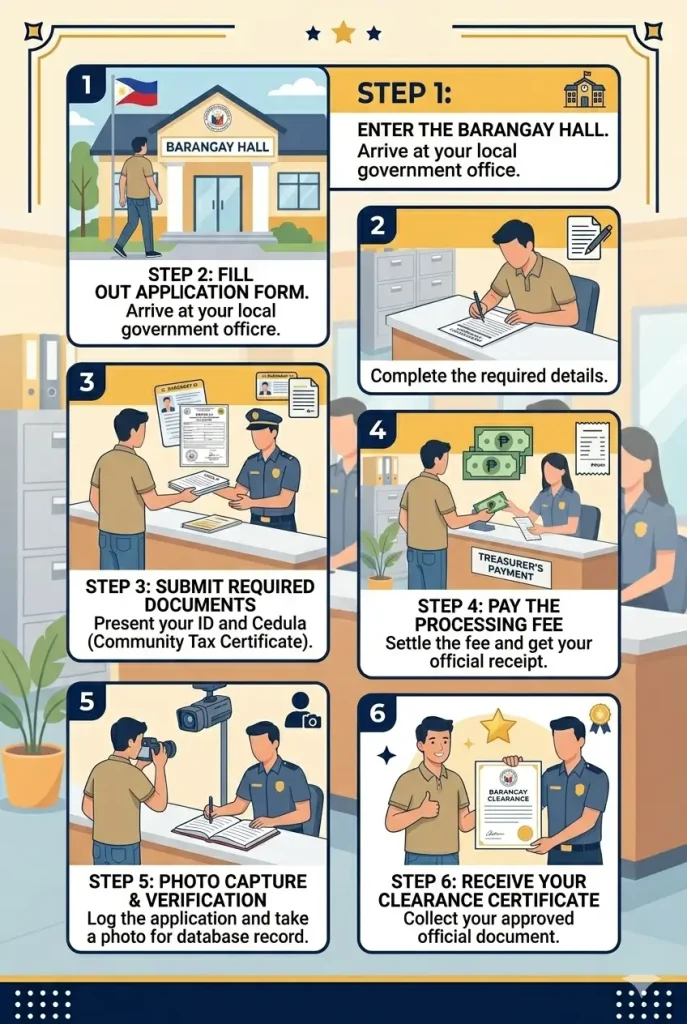
Step 1: Visit Your Local Barangay Hall
The first step is to go directly to the barangay office that covers your registered address. You cannot apply in a different barangay, even if it is nearby.
Important: A Barangay Clearance is location-based, meaning it is only issued by your home barangay.
Step 2: Request and Fill Out the Application Form
Go to the clearance or records section and ask for an application form.
Fill in your details carefully and clearly. The information you write will be used for printing your clearance, so any spelling mistake in your name or address may cause errors in your final document.
Step 3: Submit Required Documents
Once the form is completed, submit it along with your requirements:
- Completed application form
- Valid government or school ID
- Community Tax Certificate (Cedula)
If you do not have a Cedula, you can usually obtain it from the same barangay office before continuing your application.
Step 4: Pay the Processing Fee
Proceed to the designated payment counter, usually the Treasurer’s Office or cashier window, and pay the required fee.
Always request an Official Receipt (OR) as proof of payment, as it may be needed for verification during processing.
Step 5: Processing and Verification
After submission, your application will be checked by barangay officials. In some modern or urban barangays, they may also capture your photo and thumbprint for record purposes.
During verification, your name may be checked against the barangay logbook or blotter to confirm that you have no pending complaints or disputes within the community.
Step 6: Claim Your Barangay Clearance
If everything is in order, your Barangay Clearance is usually released the same day.
- Clean record: Clearance is issued immediately
- With pending issue or dispute: Processing may be delayed until the matter is resolved through barangay mediation or the Lupon system
Online Barangay Clearance Registration (Is It Really Possible?)
Many people search for “online barangay clearance” or “barangay clearance online registration,” expecting a fully digital application system. However, the reality is a bit different depending on where you live.
Is there a national online system?
There is currently no centralized national website for Barangay Clearance in the Philippines. Unlike government systems such as police or NBI clearance, each barangay operates independently under its own local government unit.
Some cities offer online services
While a nationwide system does not exist, some highly urbanized cities have their own digital platforms:
- Manila – Go Manila app
- Quezon City – QC E-Services portal
- Makati – Maka-Connect system
- Pasig – Pasig Pass platform
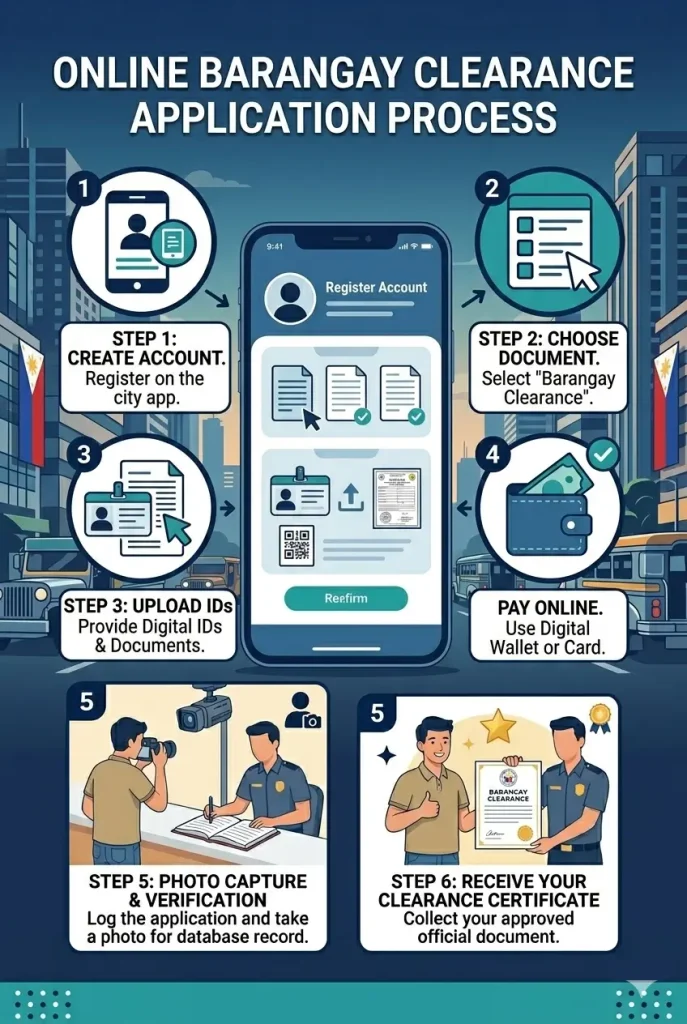
How online application works (if available)
If your city supports digital services, the process usually looks like this:
- Register on your city’s official e-services portal
- Select the Barangay Clearance option
- Upload required documents (valid ID, Cedula if needed)
- Pay online via GCash, Maya, or other payment options
- Either pick up the document at the barangay hall or download a digital copy (depending on LGU rules)
Important advice
If you live in a rural area or province, assume there is no online system available. In most cases, you will still need to apply in person at your local barangay hall.
How Much Does Barangay Clearance Cost?
The fee for Barangay Clearance is not fixed nationwide because it depends on local government ordinances.
- Standard fee: ₱50 to ₱100
- For employment purposes: usually around ₱50
- For business permits: can range from ₱200 to ₱1,000 depending on business type and size
- Free option: Under the First Time Jobseekers Assistance Act (RA 11261), first-time job seekers may get it free by presenting an Oath of Undertaking
Barangay Clearance Validity: How Long Is It Valid?
A common question among applicants is whether a Barangay Clearance expires. The answer is yes. Like many government-issued documents, it has a limited validity period and may need to be renewed depending on its purpose.
How long does a Barangay Clearance last?
Most Barangay Clearances are valid for six (6) months to one (1) year from the date they are issued. However, the exact validity may vary depending on local barangay policies and the agency requesting the document.
Where can you find the expiration date?
The validity period or issuance date is typically printed on the clearance itself. Always review the document before submitting it to ensure it is still accepted by the requesting institution.
Can the same clearance be used multiple times?
Not always. Some government offices and private organizations may require a newly issued Barangay Clearance, even if your existing one is still technically valid. For this reason, it is best to confirm the specific requirement of the agency where you will submit the document.
Using a Barangay Clearance to Get a Barangay ID
Many residents apply for a Barangay Clearance because it is often one of the requirements for obtaining a Barangay ID.
What is a Barangay ID?
A Barangay ID is a locally issued identification card that helps verify your identity and residency within the barangay.
Why do people get a Barangay ID?
It is often considered one of the easiest IDs to obtain, making it useful for individuals who do not yet have other government-issued identification documents.
Typical application process
- Apply for and obtain your Barangay Clearance
- Inquire about Barangay ID issuance at the barangay office
- Pay any applicable ID fee
- Receive your ID once processing is completed
Important reminder
While a Barangay ID may be accepted for certain local and basic transactions, some institutions may require stronger forms of identification such as a Passport, National ID, or Driver’s License.
Common Mistake: Forgetting the Cedula
One of the most common reasons applicants experience delays is forgetting to bring a Community Tax Certificate, commonly known as a Cedula.
Many people arrive with their identification and payment ready, only to discover that the barangay requires a current Cedula before processing the clearance. This often results in additional waiting time and extra trips to another office or payment counter.
How to avoid delays?
- Assume a Cedula will be required unless told otherwise
- Bring extra cash in case you need to purchase one on-site
- Secure your Cedula in a safe place after issuance, as it is often required for other government transactions
Preparing this document in advance can make the application process much smoother and faster.
Brief History of Barangay Clearance
The Barangay Clearance system traces its roots to the traditional community structure in the Philippines, where local leaders were responsible for verifying the identity and standing of residents within their area.
Today, the document continues to serve a similar purpose by providing local-level verification before individuals proceed with larger government transactions. It acts as proof that an applicant is known within the community and is generally in good standing with local authorities.
As the most basic level of community certification, the Barangay Clearance remains an important part of many official processes throughout the Philippines.
FAQs About Barangay Clearance
Conclusion
A Barangay Clearance is one of the most important local documents you may need in the Philippines. Whether you are applying for a job, opening a bank account, securing a government ID, or processing other official requirements, this document often serves as a starting point for many transactions.
Although the application process is generally straightforward, requirements, fees, and procedures may vary depending on your barangay or local government unit. Preparing the necessary documents in advance can help you avoid delays and complete the process more efficiently.
Quick Checklist Before You Apply
With the right preparation, obtaining a Barangay Clearance can be a quick and hassle-free process.
Disclaimer: This article is provided for informational and educational purposes only. We are not affiliated with any Barangay Office, Local Government Unit (LGU), or government agency. Requirements, fees, and procedures may vary by location, so it is always best to verify the latest information with your local barangay.